Master 100 Essential Conversational Phrases by Watching Top Slice-of-Life K-Dramas in 30 Days
Advertisements
Ditching rigid textbook drills for immersive television allows language learners to absorb authentic speech patterns and natural dialogue cadence effortlessly. Mastering essential Korean conversational phrases through slice-of-life K-dramas equips viewers with practical, real-world vocabulary while eliminating artificial classroom phrasing.
Authentic slice-of-life shows provide rich context for nuanced daily interactions, non-verbal social cues, and various politeness levels used in modern Seoul. Focusing on relatable workplace scenes, family dinners, and casual friend hangouts enables students to grasp functional expressions naturally through shadowing techniques and repeated contextual exposure.
Consuming structured, contextualized television media accelerates listening comprehension and builds speaking confidence within just one month. Here is your step-by-step 30-day framework for unlocking 100 core expressions directly from top-rated Korean series.
The Immersion Advantage: Why K-Dramas Work for Language Learning
Slice-of-life K-Dramas offer an unparalleled window into everyday Korean society, providing learners with authentic conversational contexts. These dramas reflect real-life interactions, from casual greetings to emotional exchanges, making them ideal for picking up practical phrases.
Unlike textbook dialogues, K-Drama conversations are dynamic, filled with nuances, slang, and cultural references that are vital for genuine communication. This immersive environment helps learners understand not just what is said, but how it is said, and the appropriate situations for its use.
The emotional engagement derived from compelling storylines also significantly enhances memory retention.
When phrases are learned in the context of a dramatic scene or a heartfelt dialogue, they become more memorable and easier to recall in real-life situations, aiding in the goal to master essential Korean conversational phrases.
Understanding the Power of Contextual Learning
Learning phrases in context, as opposed to isolated words, is a cornerstone of effective language acquisition. Slice-of-life dramas excel here by presenting language within relatable social scenarios.
Viewers witness how characters interact, express emotions, and navigate daily challenges, directly associating Korean phrases with specific situations. This contextual understanding is crucial for developing natural conversational flow and avoiding awkward miscommunications.
The repeated exposure to these phrases within varied, yet familiar, settings reinforces their meaning and usage, making the learning process intuitive and highly effective. This method is key to successfully mastering 100 essential conversational phrases by watching top slice-of-life K-Dramas in 30 days.
Structuring Your 30-Day Learning Plan
A structured approach is essential to efficiently master essential Korean conversational phrases. This plan involves selecting appropriate dramas, daily viewing routines, and active learning techniques.
Begin by committing to a daily schedule that balances watching with active phrase extraction and review. Consistency is more important than duration, with even 30-60 minutes of focused effort proving beneficial.
Break down the 100 phrases into manageable daily targets, perhaps 3-4 new phrases per day. This prevents overwhelm and allows for thorough assimilation of each new expression, directly contributing to your goal to master 100 essential conversational phrases by watching top slice-of-life K-Dramas in 30 days.
Selecting the Right Slice-of-Life K-Dramas
Choosing K-Dramas that genuinely reflect everyday life is paramount for this learning strategy. Look for series with strong character development and realistic dialogue.
Dramas focusing on school life, office dynamics, family relationships, or neighborhood interactions are often rich in common conversational patterns. Avoid historical or fantasy dramas initially, as their language may be less relevant for daily use.
Popular choices include 'Reply 1988,' 'Hospital Playlist,' 'Weightlifting Fairy Kim Bok-joo,' and 'Because This Is My First Life,' which are excellent for observing natural Korean speech. These specific dramas offer a wealth of opportunities to master 100 essential conversational phrases by watching top slice-of-life K-Dramas in 30 days.
Reply 1988: Excellent for family interactions and neighborhood banter.
Hospital Playlist: Offers professional and casual conversations among friends.
Weightlifting Fairy Kim Bok-joo: Great for youthful, relatable dialogue.
Because This Is My First Life: Features modern dating and career-related discussions.
Active Learning Techniques While Watching
Passive viewing, while enjoyable, is insufficient for language mastery. To truly Master essential Korean conversational phrases, active engagement is crucial.
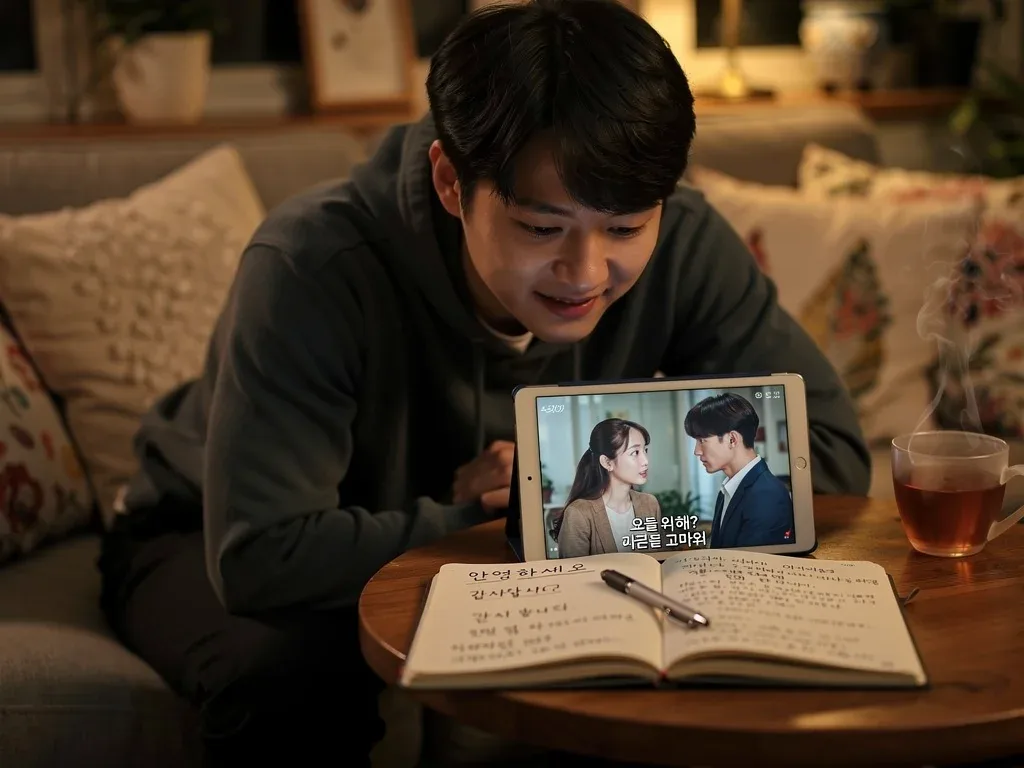
This involves pausing, repeating, and noting down phrases. Keep a dedicated notebook or digital document to record new expressions, their meanings, and the context in which they appear.
Utilize dual subtitles (Korean and English) initially, then transition to Korean-only subtitles as your comprehension improves. This gradual removal of English support forces your brain to process the Korean directly, accelerating learning.
The Power of Repetition and Shadowing
Repetition is a time-tested method for solidifying new language patterns. When you encounter a useful phrase, pause the drama and repeat it aloud multiple times.
Shadowing, where you mimic the intonation and speed of the actors, is particularly effective for improving pronunciation and natural rhythm. This technique helps bridge the gap between understanding and producing speech.
Don't be afraid to sound awkward at first; consistent practice will refine your accent and make the phrases feel more natural. This active vocalization is key to your success in mastering 100 essential conversational phrases by watching top slice-of-life K-Dramas in 30 days.
Pause and Repeat: Isolate phrases and say them aloud until comfortable.
Shadowing: Mimic actors' speech patterns, intonation, and speed.
Record Yourself: Compare your pronunciation to the original dialogue.
Contextual Recall: Try to recall phrases when you encounter similar situations in daily life.
Key Conversational Phrase Categories to Focus On
To effectively Master essential Korean conversational phrases, categorize phrases into functional groups. This makes learning more organized and practical.
Focus on common social interactions: greetings, introductions, expressing agreement or disagreement, asking for clarification, and showing empathy. These form the backbone of daily communication.
Include phrases related to daily routines, emotions, and common requests. By targeting these categories, learners build a versatile vocabulary that can be applied in numerous real-world scenarios, directly from the K-Drama context.
Essential Greetings and Farewells
Mastering basic greetings and farewells is fundamental for any language learner. K-Dramas provide numerous examples of these in various social settings.
Beyond "Annyeonghaseyo," learn context-specific greetings like "Jal jinaesseoyo?" (Have you been well?) or "Bap meogeosseoyo?" (Have you eaten?), which often serve as informal greetings in Korean culture.
For farewells, differentiate between "Annyeonghi gyeseyo" (stay well) and "Annyeonghi gaseyo" (go well), understanding when to use each based on who is leaving. These nuances are vital for authentic interaction and are easily observed in slice-of-life K-Dramas.
Overcoming Challenges and Staying Motivated
Learning a new language can present challenges, from understanding rapid speech to memorizing new vocabulary. Staying motivated is crucial to successfully Master essential Korean conversational phrases.
Break down your learning into smaller, achievable goals. Celebrate small victories, like understanding a new phrase without subtitles or correctly using an expression in practice.
Connect with other K-Drama fans or language learners. Sharing experiences and tips can provide encouragement and new perspectives, fostering a supportive learning environment.
Dealing with Fast Speech and Slang
Korean speech in K-Dramas can often sound very fast to new learners, and slang is prevalent. This can be a significant hurdle, but it's surmountable with the right strategies.
Start by slowing down playback speed if available, or replaying short segments multiple times. Focus on identifying key words rather than understanding every single word, which will come with practice.
Embrace slang as part of authentic language. While not always appropriate for formal settings, understanding common slang used in slice-of-life dramas will deepen your comprehension and connection to the culture. This is an integral part of mastering 100 essential conversational phrases by watching top slice-of-life K-Dramas in 30 days.
Integrating Your Learning into Daily Life
The ultimate goal of learning conversational phrases is to use them. Actively seek opportunities to integrate your newly acquired Korean into your daily life, even if it's just practicing with yourself.
Think in Korean: try to narrate your daily activities or internal thoughts using the phrases you've learned. This internal practice reinforces your understanding and recall.
If possible, find language exchange partners or local Korean cultural events. These real-world interactions provide invaluable practice and build confidence, solidifying your ability to master 100 essential conversational phrases by watching top slice-of-life K-Dramas in 30 days.

Practicing with Native Speakers or Language Exchange Partners
Engaging with native Korean speakers is perhaps the most effective way to test and refine your conversational skills. Online platforms and local community groups often facilitate such exchanges.
Don't be afraid to make mistakes; they are part of the learning process. Native speakers are usually patient and appreciative of your efforts to learn their language.
Focus on using the phrases you've specifically learned from K-Dramas. This helps bridge the gap between passive understanding and active production, making your goal to master 100 essential conversational phrases by watching top slice-of-life K-Dramas in 30 days a reality.
Beyond 30 Days: Sustaining Your Korean Language Journey
Mastering 100 essential conversational phrases in 30 days is a significant achievement, but it's just the beginning. Language learning is a continuous journey that requires ongoing effort and engagement.
Continue watching K-Dramas, but expand your repertoire to different genres and even Korean variety shows, which offer more spontaneous and unscripted dialogue. This broadens your exposure to various speech patterns and vocabulary.
Consider enrolling in formal Korean classes or using language learning apps to supplement your K-Drama immersion. These resources can provide structured grammar lessons and deeper linguistic insights, reinforcing what you've learned from your favorite shows.
Expanding Your Vocabulary and Grammatical Understanding
Once you have a solid foundation of conversational phrases, begin to focus on expanding your vocabulary systematically. Use flashcards, vocabulary apps, and make a conscious effort to learn new words daily.
Delve deeper into Korean grammar. While K-Dramas provide implicit grammatical context, explicit study of grammar rules will help you construct your own sentences and understand more complex structures.
Regularly review the 100 phrases you mastered, ensuring they remain fresh in your memory. Consistent review and active application are key to long-term retention and continued progress in your Korean language journey.
Key Point | Brief Description |
|---|---|
Immersion Strategy | Learn practical Korean phrases directly from authentic K-Drama dialogues. |
Structured Plan | Daily viewing, active note-taking, and repetition over 30 days. |
Active Learning | Pause, repeat, shadow, and categorize phrases for better retention. |
Continued Growth | Expand beyond 30 days with diverse content and formal study. |
Frequently Asked Questions About Learning Korean with K-Dramas
How realistic is it to master 100 phrases in 30 days?▼
It is very realistic with consistent daily effort. By focusing on 3-4 new phrases daily and actively reviewing them, learners can effectively internalize 100 essential conversational phrases. The immersive context of K-Dramas significantly aids this rapid acquisition and retention.
Which K-Drama genres are best for conversational Korean?▼
Slice-of-life dramas are ideal due to their focus on everyday situations and natural dialogue. Genres like romance, family dramas, and workplace comedies provide excellent exposure to common conversational patterns. Avoid historical or fantasy dramas initially, as their language may be less practical for daily use.
Do I need to understand grammar to start learning this way?▼
While a basic understanding of grammar helps, it's not strictly necessary to begin. This method focuses on absorbing phrases as complete units, much like native speakers learn their first language. Grammar can be studied in parallel or introduced gradually as you build your phrase repertoire.
How important are subtitles in this learning process?▼
Subtitles are crucial tools. Start with dual subtitles (Korean and English) to grasp meaning, then transition to Korean-only subtitles to train your ear and reading skills. Eventually, try watching without subtitles to test your comprehension. They are essential for identifying and understanding new phrases.
What if I get stuck or lose motivation during the 30 days?▼
It's normal to face challenges. Revisit your favorite K-Drama scenes, connect with other learners, or take a short break to avoid burnout. Remember your initial motivation and the joy of understanding your favorite shows. Consistency, even in small doses, is key to success.
Perspectives
The strategy to Master essential Korean conversational phrases represents a significant shift in language acquisition, moving from rote memorization to contextual immersion.
This approach not only accelerates learning but also fosters a deeper cultural understanding, making it highly effective for K-Drama enthusiasts.
As global interest in Korean culture continues to grow, such innovative methods are poised to become standard for aspiring Korean speakers, emphasizing practical application and authentic communication.