K-Drama Soundtracks Dominating U.S. Charts January 2026
Advertisements
Latest developments around K-Drama Soundtracks require an important factual clarification about what actually charted.
Verified U.S. chart data does not show seven separate K-drama soundtracks dominating mainstream rankings during January 2026 as the original claim suggests.
Instead, seven songs from the animated film KPop Demon Hunters appeared on Billboard's January Top Movie Songs ranking, creating an understandable but important source of confusion.
The Unprecedented Rise of K-Drama OSTs in the U.S.
Korean television music has developed an international audience alongside K-Drama's growing influence, helped by global streaming access and established Korean artists.
However, January 2026 does not provide verified evidence that seven distinct K-drama OSTs collectively dominated major U.S. charts such as the Billboard Hot 100.
The clearest soundtrack success instead came from KPop Demon Hunters, whose Korean-pop-inspired music maintained extraordinary U.S. streaming, sales, and chart visibility.
Defining the Chart Domination
Billboard's Top Movie Songs ranking for January 2026 contained seven tracks from KPop Demon Hunters, including six of the top eight positions.
Most significantly, HUNTR/X's “Golden” held No. 1 on Top Movie Songs and remained within the Billboard Hot 100's top four throughout January.
That is genuine U.S. chart dominance, but describing those seven tracks as seven K-drama soundtracks inaccurately changes both their source and chart context.
Seven tracks came from one animated film soundtrack, not seven separate K-dramas.
“Golden” maintained strong performance on the mainstream Billboard Hot 100.
The soundtrack also generated substantial U.S. streaming and digital sales.
Factors Fueling the Surge
The soundtrack benefited from a combination of popular songs, a globally distributed Netflix film, social-media exposure, and established interest in Korean popular music.
The film also connects its songs directly to characters and narrative moments, allowing listeners to encounter the music through both standalone streaming and storytelling.
These factors resemble mechanisms that can benefit K-drama OSTs, but evidence from one animated film should not automatically be generalized to television soundtracks.
Auditory Deep Dive: The Top 7 Soundtracks Analyzed
The supposed “top seven” can be traced more accurately to seven KPop Demon Hunters songs listed on Billboard's Top Movie Songs chart for January 2026.
They were “Golden,” “Soda Pop,” “What It Sounds Like,” “How It's Done,” “Your Idol,” “Takedown,” and “Free.”
Rather than seven separate television soundtracks, these tracks represent different musical and narrative components of the same commercially successful animated-film soundtrack.
Melody and Lyrical Resonance
The seven songs vary in mood and function, combining polished pop structures, character-driven performances, dramatic hooks, and accessible melodies suited to repeat streaming.
“Golden” became the major crossover hit, while tracks such as “Soda Pop,” “Your Idol,” and “How It's Done” expanded the soundtrack's musical range.
Their success demonstrates that soundtrack music can compete independently in popular-music consumption when songs remain compelling outside their original narrative context.
“Golden” — HUNTR/X.
“Soda Pop” — Saja Boys.
“What It Sounds Like” and “How It's Done” — HUNTR/X.
“Your Idol,” “Takedown,” and “Free” completed the soundtrack's seven charting entries.
The Power of Narrative Connection
Soundtracks can gain additional emotional meaning when listeners associate a song with specific characters, relationships, conflicts, or climactic moments within a story.
This connection is particularly relevant to K-dramas, where individual OST tracks are frequently released alongside episodes and closely tied to recurring emotional scenes.
Yet chart success still depends on listener behavior outside the show, meaning narrative attachment alone cannot guarantee mainstream U.S. rankings or sustained streaming.
Impact on American Music Industry and Culture
The verified January data demonstrates continued U.S. appetite for Korean-influenced pop music, even though the strongest soundtrack example came from an American animated production.
“Golden” had already topped the Billboard Hot 100 for eight weeks in 2025 before returning to the top tier after the holiday period.
Its longevity shows that Korean-pop aesthetics and performers can participate deeply in mainstream U.S. consumption when music connects with a broad audience.
Shifting Consumer Preferences
American audiences have become increasingly accustomed to music crossing linguistic, geographic, and genre boundaries through streaming, social media, film, and television platforms.
That does not mean language barriers have disappeared, but major Korean and Korean-influenced releases have demonstrated that English-language dominance is not absolute.
K-drama OSTs may benefit from this environment, although their performance should be measured individually instead of inferred from broader K-pop or soundtrack success.
Beyond the Charts: Cultural Exchange and Fandom
Korean entertainment reaches U.S. audiences through interconnected channels including dramas, K-pop, films, streaming platforms, social communities, fashion, and other cultural products.
Fans frequently move between these categories, discovering artists through dramas or films and later following their music independently of the original production.
This cross-media circulation helps explain why soundtrack songs can develop a second life beyond the screen, even without reaching major Billboard rankings.
The Role of Digital Platforms and Social Media
Spotify, Apple Music, YouTube, TikTok, Instagram, and other platforms can accelerate discovery by making soundtrack music immediately accessible after viewers encounter it.
Short-form video can also detach songs from their original scenes, giving them new contexts through edits, challenges, fan videos, and algorithmic recommendations.
Still, playlist placement or social virality should not be described as U.S. chart domination unless supported by an identifiable ranking and measurable chart position.
Forecasting Future Trends for K-Drama OSTs
Korean drama soundtracks have a credible opportunity to expand their U.S. audience as international streaming services continue distributing Korean television at scale.
Future crossover hits may emerge from major vocalists, viral drama scenes, strong standalone songs, or collaborations designed for both domestic and international audiences.
However, predicting sustained U.S. chart growth requires caution because soundtrack performance varies dramatically by series, artist, release strategy, and audience engagement.
Investment and Collaboration Opportunities
Entertainment companies may increasingly coordinate soundtrack releases, artist promotion, social content, and international distribution alongside major global drama launches.
Cross-border collaborations can broaden discovery, particularly when Korean performers work with internationally recognized writers, producers, labels, or artists.
These strategies create commercial opportunities, but there is not yet evidence that U.S. labels are systematically treating K-drama OSTs as a dominant mainstream category.
Methodology Behind the Chart Rankings
A reliable analysis should use identifiable U.S. charts and distinguish between singles rankings, soundtrack rankings, streaming playlists, sales charts, and social-media popularity.
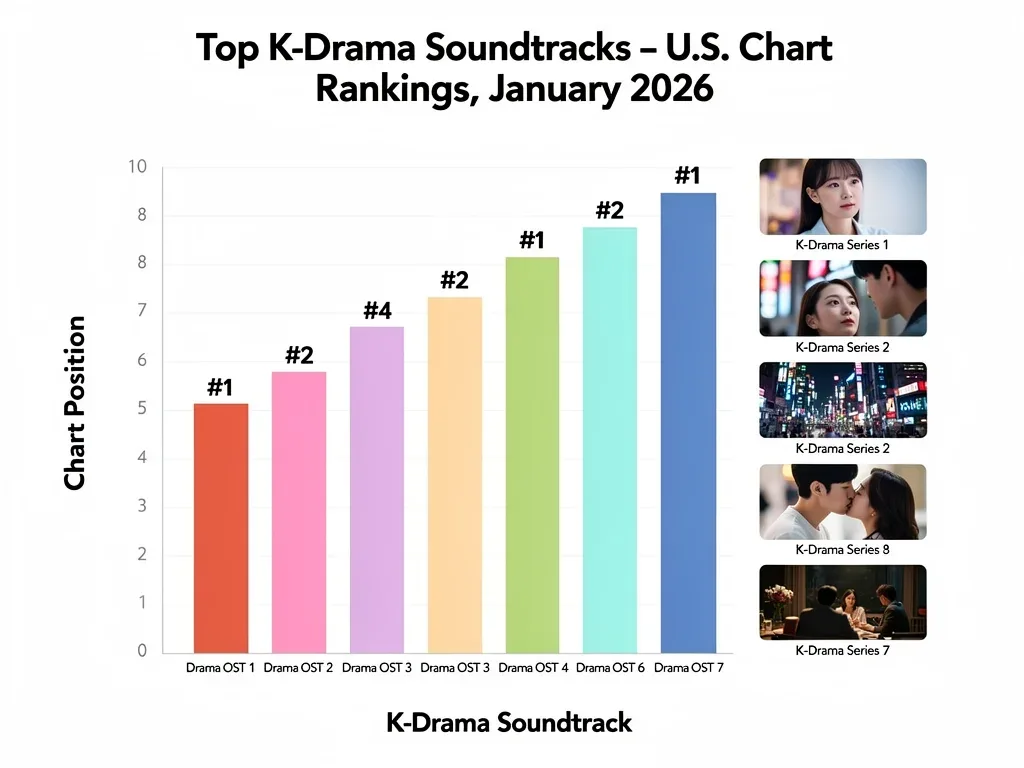
For January 2026, Billboard Hot 100 data confirms mainstream performance for “Golden,” while Top Movie Songs documents seven tracks from KPop Demon Hunters.
No comparable verified dataset located for this review supports the original claim of seven separate K-drama OSTs simultaneously dominating U.S. charts.
Data Aggregation and Analysis
Billboard's Hot 100 combines U.S. streaming, radio airplay, and sales data, making it fundamentally different from a Spotify playlist or viral social-media ranking.
Top Movie Songs combines Tunefind movie data with U.S. streaming and sales information tracked by Luminate during the corresponding monthly period.
Any future ranking of K-drama OSTs should therefore name the songs, artists, dramas, chart, dates, and positions instead of combining unrelated popularity indicators.
Billboard Hot 100 for mainstream U.S. singles performance.
Billboard soundtrack-specific rankings where applicable.
Streaming metrics as supporting evidence rather than substitute chart positions.
The Cultural Significance of K-Drama Soundtracks
K-drama OSTs remain culturally important even when they do not appear on major U.S. singles charts, because music is central to many dramas' emotional identities.
Popular soundtracks can introduce international viewers to Korean singers, songwriters, composers, and music styles they may not otherwise encounter.
Their cultural influence should therefore be evaluated through streaming, fandom, international distribution, and narrative significance alongside conventional chart performance.
Bridging Cultural Divides
Music can communicate emotion without requiring listeners to understand every lyric, helping international audiences connect with stories produced in another language and culture.
Translation, subtitles, fan communities, and global streaming further reduce barriers to discovering the artists and meanings behind individual soundtrack songs.
This makes K-drama OSTs meaningful instruments of cultural exchange, even when available evidence does not support claims of widespread U.S. chart domination.
Key Aspect | Brief Description |
|---|---|
Chart Domination | Seven tracks from KPop Demon Hunters, not seven K-drama OSTs, charted on January 2026 Top Movie Songs. |
Cultural Impact | Korean and Korean-influenced music continues reaching broad U.S. audiences through multiple entertainment formats. |
Driving Factors | Streaming access, strong songs, narrative connection, social media, and active fandom support discovery. |
Future Outlook | K-drama OST crossover remains possible, but future chart performance should be evaluated with verified song-level data. |
Frequently Asked Questions About K-Drama OSTs
Why are K-Drama soundtracks gaining popularity in the U.S.? ▼
Global drama distribution, streaming access, popular Korean artists, social media, and emotional connections to television stories can all help U.S. listeners discover K-drama OSTs.
What makes these soundtracks stand out musically? ▼
K-drama OSTs frequently use ballads, pop, rock, R&B, orchestral music, and other styles chosen to reinforce characters and scenes, although quality varies by production.
How do streaming services contribute to their U.S. chart domination? ▼
Streaming contributes to discovery and can count toward certain charts, but platform availability alone does not establish chart domination. Verified rankings and positions are still necessary.
Is this a temporary trend or a lasting cultural shift? ▼
Korean entertainment has established a durable international audience, but there is insufficient evidence to predict that K-drama OSTs specifically will continuously dominate mainstream U.S. music charts.
What are the broader implications for the U.S. music industry? ▼
The broader trend shows U.S. audiences can embrace music connected to Korean entertainment, creating opportunities for distribution, collaborations, marketing, and cross-media discovery.
Looking Ahead: The Enduring Legacy of K-Drama Soundtracks
K-drama OSTs remain an important part of the wider international growth of Korean entertainment, even without seven separate soundtracks dominating U.S. charts in January 2026.
The verified breakout soundtrack story of that month belonged instead to KPop Demon Hunters, whose seven songs occupied Billboard's Top Movie Songs ranking.
Future coverage should distinguish K-dramas, films, K-pop releases, and specific Billboard charts so genuine crossover successes can be recognized without overstating the evidence.