Interactive Drama: New Formats Transforming Storytelling

Advertisements
Interactive drama formats are evolving across live theater, games and digital entertainment in 2026. Immersive productions continue attracting audiences, while traditional streaming-style branching films have lost momentum and generative AI is opening new experimental possibilities for adaptive storytelling.
Interactive drama formats are changing the relationship between audiences and stories by giving participants greater influence over what they see, where they move or how a narrative develops.
The most important developments in 2026 are not limited to one medium, with immersive theater, narrative games, live participation and experimental AI-generated storytelling following different creative paths.
Understanding these distinctions helps explain why interactive entertainment remains active even though some highly publicized formats, particularly choose-your-own-path streaming films, have become less prominent.
Advertisements
The State of Interactive Drama Formats in 2026
Interactive storytelling remains an active field in the United States, but its development is increasingly spread across theater, games, live experiences and experimental digital platforms.
Rather than replacing conventional television or theater, these formats provide alternative experiences in which audience movement, decisions or participation can influence how a story is encountered.
The result is a diverse category where interactive drama formats can range from physically immersive productions to narrative games and AI-assisted experiments with adaptive storytelling.
Audience Participation Takes Different Forms
Participation does not always mean choosing between two buttons on a screen, because interactive storytelling can involve physical exploration, conversation, puzzle solving or real-time audience voting.
Some experiences provide substantial control over narrative direction, while others preserve a predetermined story but allow participants to decide which characters, rooms or events they encounter.
This distinction matters because audience agency exists on a spectrum rather than functioning as one standard feature shared by every interactive production.
Interactive Entertainment Is Not One Single Market
Immersive theater depends on venues, performers and physical attendance, while digital interactive stories can reach audiences through games, mobile devices and other software platforms.
These formats therefore face different production costs, distribution challenges and measurements of success despite sharing an emphasis on participation.
Grouping them together is useful for discussing experimentation, but creators and audiences should recognize that each medium operates under different artistic and commercial conditions.
Immersive Theater Continues After Sleep No More
Immersive theater remains one of the most visible forms of interactive drama because participants physically enter environments designed as part of the story.
Performers, scenery, sound and movement can surround the audience instead of remaining separated by a conventional stage and fixed seating arrangement.
The format continues evolving in 2026 even though one of its most influential American productions, Sleep No More, has already ended its New York run.
Sleep No More Is Now a Historical Reference
Sleep No More became an influential example of immersive theater by allowing masked spectators to explore multiple floors and follow performers through a loosely structured interpretation influenced by Macbeth.
The New York production ran for approximately 14 years before closing in 2025, meaning it should no longer be described as an active current attraction.
Its influence remains important because later immersive productions continue using environmental exploration, fragmented storytelling and audience movement as central components of the experience.
Masquerade Shows the Format Remains Active in 2026
Off-Broadway production Masquerade demonstrates that large-scale immersive theater continues attracting audiences after the end of Sleep No More.
The production reimagines The Phantom of the Opera as an immersive experience in which spectators move through a purpose-built environment rather than watching exclusively from traditional seats.
Its multiple extensions into 2026 illustrate continued interest in theatrical formats that combine recognizable stories with physical exploration and close audience proximity.
How Immersive Theater Creates Audience Agency
Immersive theater often gives participants freedom to choose where they move and what they observe without giving them complete control over the underlying dramatic structure.
A spectator may follow one performer while another audience member explores a different room, producing two substantially different experiences from the same production.
This selective access to information creates personalization through perspective rather than requiring the narrative itself to branch into entirely separate endings.
Environment Becomes Part of the Story
Rooms, objects, lighting, music and spatial design can communicate narrative information without requiring actors to explain every development directly to the audience.
Participants may discover letters, props or visual clues that alter their understanding of characters and events even when those discoveries do not change the scripted outcome.
This environmental storytelling distinguishes many immersive productions from conventional theater and makes physical space an active component of the dramatic experience.
Direct Interaction Varies From Production to Production
Some productions permit performers to speak directly with audience members, assign tasks or conduct brief one-to-one scenes that create a stronger sense of personal involvement.
Other experiences limit direct intervention and instead allow spectators to observe closely while choosing their own route through the environment.
Because these rules vary widely, audiences should not assume that every immersive production allows them to influence characters or determine major plot outcomes.
- Audience members may move through the performance environment.
- Different routes can reveal different parts of the story.
- Direct actor interaction may be included but is not universal.
- The story can remain scripted even when the viewing experience changes.
Branching Narratives Have Shifted Away From Streaming Specials
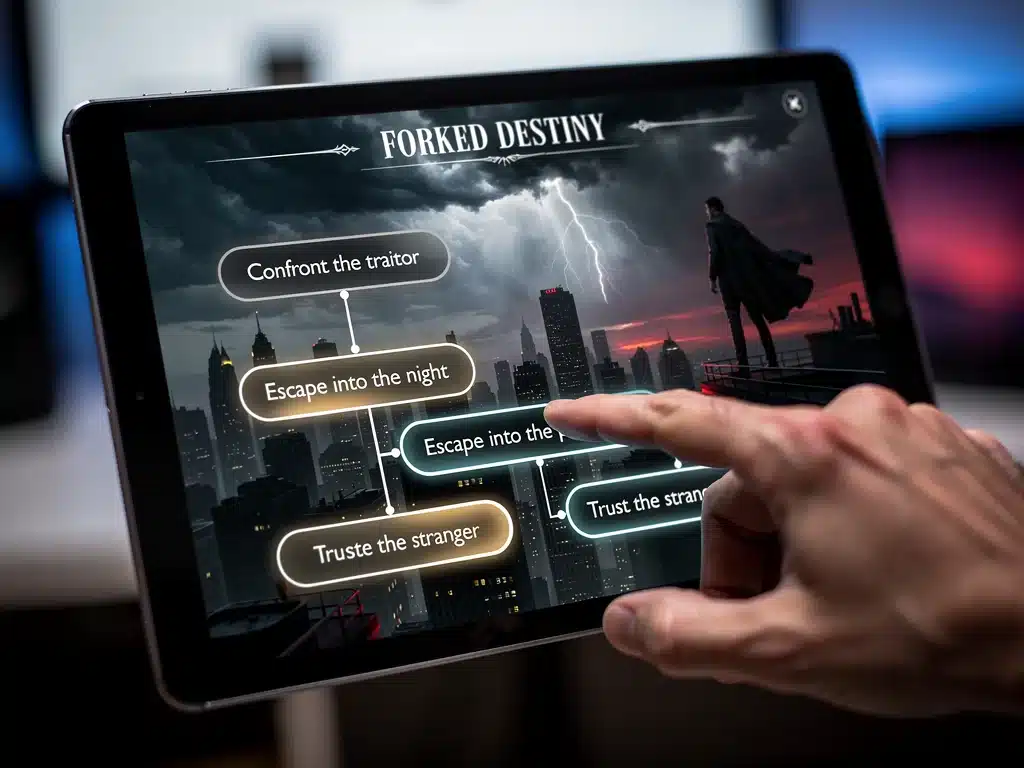
Branching narratives allow users to make choices that determine which scene, event or outcome appears next, creating multiple possible routes through a story.
The format became highly visible when streaming platforms experimented with interactive films and television specials during the late 2010s and early 2020s.
By 2026, however, the strongest growth in interactive entertainment is no longer centered on conventional choose-your-own-path streaming movies.
Bandersnatch Remains an Important Historical Example
Netflix’s 2018 Black Mirror: Bandersnatch became one of the best-known mainstream experiments with viewer-controlled branching storytelling in home entertainment.
The film presented choices during playback that could redirect scenes and produce different narrative developments, encouraging viewers to replay the experience and explore alternative paths.
Its cultural significance remains useful for explaining branching narratives, but it should now be treated primarily as a milestone rather than evidence of current streaming expansion.
Netflix Pulled Back From Interactive Films
Netflix removed most of its interactive titles beginning in late 2024 and removed its remaining prominent interactive specials, including Bandersnatch, from the interactive catalog in 2025.
The company indicated that the technology supporting these experiences had become limiting as its entertainment strategy shifted toward other areas, including games.
This reversal demonstrates that mainstream attention does not guarantee that a particular form of interactive drama format will become a permanent streaming standard.
Games Are Increasingly Important to Interactive Storytelling
Video games naturally support narrative participation because players can control characters, explore environments and make decisions while interacting with rule-based systems.
Story-focused games can therefore offer forms of agency that are difficult to reproduce inside conventional film or television interfaces.
As streaming companies experiment with games and entertainment franchises across multiple media, the boundary between interactive drama and narrative gaming becomes increasingly difficult to define.
Choices Can Be Embedded in Gameplay
A narrative game can respond to dialogue selections, exploration decisions, relationships or player performance rather than presenting only occasional binary choices.
This allows story consequences to emerge from actions performed throughout the experience instead of requiring a dedicated prompt every time the narrative branches.
The amount of genuine narrative variation still depends on design, since many games eventually reconnect different paths to keep production complexity manageable.
Streaming Brands Are Exploring Games Instead of Only Interactive Films
Netflix continues offering a large catalog of games to subscribers, including titles connected with television and film properties available elsewhere on the service.
In 2025, the company also released Thronglets, a game tied narratively to the Black Mirror universe and connected with themes previously explored through Bandersnatch.
This suggests that cross-media games may provide one route for interactive storytelling even as dedicated branching-film technology becomes less central to streaming strategy.
Artificial Intelligence Creates New Adaptive Storytelling Possibilities
Generative artificial intelligence is giving researchers and developers new ways to create narrative material dynamically instead of prewriting every possible branch in advance.
In theory, an AI-supported system can interpret player actions and generate dialogue, events or variations within boundaries defined by designers.
This approach could expand interactive drama formats, but current research also shows substantial challenges involving narrative coherence, authorial control and consistency.
AI Can Expand the Number of Possible Story Paths
Traditional branching stories become increasingly expensive to build as writers create more decision points, scenes and alternative outcomes for participants to explore.
Generative systems can potentially produce some narrative variations during play, reducing the need to manually author every possible response beforehand.
Research prototypes are exploring methods that allow creators to establish narrative boundaries while AI generates content inside those controlled spaces.
Creative Control Remains a Major Challenge
Giving an AI system greater freedom can make narratives more responsive, but it also increases the possibility of contradictions, irrelevant events or character behavior that violates the intended story.
Recent research into AI-generated interactive fiction has found that generating technically functional scenarios does not automatically produce consistently coherent or engaging storytelling.
Human authors therefore remain important for establishing tone, character logic, narrative constraints and quality-control processes around AI-generated content.
AI Personalization Should Not Be Confused With True Narrative Agency
Personalization can modify recommendations, difficulty or selected content without necessarily allowing the audience to influence the central dramatic events of a story.
An AI system might adapt dialogue style or surface different scenes while keeping the same major narrative structure for every participant.
For that reason, creators should distinguish personalization from genuine branching agency when describing new interactive drama formats.
Real-Time Adaptation Is Still Experimental
Research systems demonstrate that generative models can react dynamically to participant input, but large-scale commercial dramatic productions require far greater reliability and creative consistency.
Creators also need mechanisms for moderation, safety, intellectual property management and predictable character behavior when generated content can change during each session.
These requirements make truly open-ended adaptive drama more technically and editorially challenging than a demonstration in which an AI simply generates dialogue.
Biometric Storytelling Should Not Be Presented as a Standard Trend
Experimental systems can potentially use physiological or behavioral signals to influence interactive experiences, but biometric adaptation is not currently a standard feature of mainstream U.S. dramatic entertainment.
Collecting biometric information also creates privacy, consent and data-security considerations that must be addressed before such systems could become widely deployed.
It is therefore more accurate to describe biometric storytelling as an experimental research direction rather than an expected near-term feature of ordinary interactive drama.
Virtual and Augmented Reality Offer Different Forms of Immersion
Virtual reality can place users inside simulated environments where looking, moving and interacting with objects become part of the storytelling experience.
Augmented reality instead layers digital elements onto physical surroundings, allowing creators to combine real environments with fictional characters, clues or interactive information.
Both technologies can support interactive drama formats, but neither has replaced conventional screens or live performance as the dominant way audiences consume dramatic entertainment.
VR Can Increase Spatial Presence
Head-mounted displays allow users to experience three-dimensional environments from an embodied perspective that differs substantially from watching a conventional flat screen.
This can make positioning, distance and movement narratively meaningful, especially when the participant can interact with characters or explore spaces independently.
The format still faces practical limitations including hardware requirements, comfort, accessibility, production complexity and the smaller audience reachable compared with standard video distribution.
AR Can Connect Digital Stories With Real Places
Augmented reality can use phones, glasses or other devices to place narrative information over locations that audiences are already physically exploring.
This creates possibilities for location-based mysteries, exhibitions and performances in which digital content complements real architecture or public spaces.
Successful execution requires careful design because technological novelty alone does not ensure that the resulting experience will have meaningful dramatic structure.
Production Complexity Limits Large Branching Narratives
One of the persistent challenges for interactive storytelling is that audience choice can multiply the number of scenes, outcomes and production assets creators must build.
A story with several decisions can quickly generate dozens of theoretical pathways, even when writers later reconnect some branches to control scope.
This creates financial and creative pressure that conventional linear storytelling does not experience to the same extent.
Not Every Choice Can Create a Completely Different Story
Many branching narratives use converging structures in which different decisions temporarily change events before returning participants to shared major story points.
This allows creators to preserve a sense of agency while limiting the amount of entirely separate content that must be produced.
The challenge is making these choices feel meaningful even when several pathways eventually lead toward similar narrative destinations.
Immersive Theater Has a Different Scalability Problem
Live immersive productions must manage physical space, performers and audience capacity, making expansion more difficult than simply distributing another digital copy.
A highly personalized encounter may require small groups or one-to-one performer interactions, which can increase labor requirements for each audience member served.
Creators therefore balance intimacy and participation against ticket capacity, venue costs and the practical limits of live production.
Measuring Success Requires More Than Audience Participation
Interactive productions can collect information about choices, routes, completion rates or repeated sessions that conventional theater and film may not generate as directly.
Those measurements can help creators understand how audiences navigate an experience, but high interaction alone does not demonstrate that the underlying story is successful.
Engagement should therefore be interpreted alongside audience satisfaction, narrative clarity, accessibility and the production’s artistic or commercial goals.
Replayability Can Be Useful but Is Not Required
Branching games and films often encourage participants to replay an experience to discover alternative endings, hidden scenes or consequences from different choices.
Immersive theater may create similar curiosity by allowing repeat visitors to follow different performers or explore previously unseen parts of the environment.
A production can still succeed without substantial replayability, particularly when the intended experience is designed to be emotionally complete after one participation.
Audience Data Creates Privacy Considerations
Digital interactive systems can record decisions, play patterns and other behavioral information that creators may use to analyze audience engagement.
If systems expand toward personalized AI or biometric interaction, the amount and sensitivity of collected data could become substantially greater.
Clear consent, appropriate data handling and transparent explanations will become increasingly important if personalization depends on detailed information about participants.
Interactive Drama Is Blurring the Boundaries Between Media
Interactive drama formats increasingly combine techniques traditionally associated with theater, film, video games, exhibitions and digital media rather than fitting cleanly into one category.
A production can include live performers, projected video, mobile interaction and game mechanics while still organizing the experience around a dramatic narrative.
This multidisciplinary structure creates opportunities for experimentation but also requires collaboration among professionals with very different creative and technical skills.
Game Design Has Become Important to Dramatic Experiences
When an audience can make choices, creators must consider rules, feedback and consequences in addition to character development and traditional dramatic structure.
These concerns are familiar to game designers, who routinely build systems that explain how player actions affect the world around them.
Interactive productions therefore often benefit from treating participation as a designed system instead of simply allowing audiences to move freely without meaningful consequences.
Theater Contributes Embodied Interaction
Live performance offers physical proximity, unpredictability and human responsiveness that prerecorded digital media can struggle to reproduce convincingly.
An actor can adjust timing or attention in response to a participant while still remaining within the boundaries established by the production.
This capacity for real-time human adaptation explains why immersive theater remains a distinctive branch of interactive storytelling even as digital technologies become more sophisticated.
Regional Centers Continue Supporting Immersive Work
New York remains an important U.S. center for immersive performance because its theater infrastructure, audiences and production community can support unusual site-specific projects.
Los Angeles also offers opportunities through its entertainment industry and experimental performance communities, although individual productions can appear in many other cities.
Digital distribution further reduces geographic limitations for interactive games and software-based experiences, allowing creators outside major entertainment centers to reach national audiences.
New York Is Evolving Beyond Sleep No More
The closure of Sleep No More did not mark the end of immersive theater in New York, where new productions continue experimenting with audience movement and unconventional venues.
Masquerade is one prominent 2026 example, while smaller immersive productions have also drawn on artists and techniques developed through earlier New York work.
This continuity suggests that the format is evolving through new productions rather than depending indefinitely on one long-running landmark show.
Digital Interactive Stories Are Less Geographically Restricted
Games and other software-driven experiences can reach audiences without requiring spectators to travel to a particular theater or city.
This lowers some distribution barriers while introducing different challenges involving platform access, development costs, device compatibility and audience discovery.
Digital distribution therefore broadens potential reach but does not automatically make ambitious interactive storytelling inexpensive or commercially successful.
What to Watch Next for Interactive Drama Formats
The next stage of interactive drama formats will likely involve experimentation across multiple media rather than one single technology becoming the dominant storytelling model.
Immersive theater continues refining live participation, games provide mature frameworks for narrative agency and generative AI creates new possibilities for adaptive story systems.
Creators and audiences should watch how these approaches combine while remaining cautious about predictions that every emerging technology will fundamentally replace established forms of drama.
AI-Assisted Story Systems Will Need Stronger Authoring Tools

Generative models can expand narrative possibilities, but creators need tools that allow them to control tone, character behavior and the boundaries within which generated events occur.
Current research increasingly focuses on giving authors oversight rather than allowing AI to determine every element of the story independently.
Progress in this area could determine whether AI-generated interaction develops into reliable commercial storytelling or remains primarily an experimental technique.
Live and Digital Interaction May Continue Converging
Future productions may combine physical venues with phones, projections, games or AI-supported characters rather than treating live and digital storytelling as separate categories.
Hybrid experiences can use technology to extend participation while preserving the human performance and spatial qualities that make immersive theater distinctive.
The strongest developments are likely to be those where technology serves a clear narrative purpose rather than being included simply because it is new.
| Format Type | 2026 Context |
|---|---|
| Immersive Theater | Live productions continue after Sleep No More, with experiences such as Masquerade demonstrating ongoing interest. |
| Branching Streaming Films | Bandersnatch remains historically important, but Netflix moved away from its earlier interactive-special strategy. |
| Narrative Games | Games remain a major medium for combining user choices, exploration and dramatic storytelling. |
| AI-Adaptive Stories | Research is expanding, but coherence, creative control and reliability remain major challenges. |
| VR and AR | These technologies offer new forms of spatial immersion but remain complementary rather than dominant entertainment formats. |
Frequently Asked Questions About Interactive Drama Formats
Interactive storytelling gives the participant some influence over how a narrative is experienced. That influence can involve choices, movement, exploration, conversation or gameplay and does not always require changing the final ending.
No. The influential New York production closed in 2025 after approximately 14 years. It remains an important reference for immersive theater, while newer productions continue developing the format.
No. Bandersnatch remains a major historical example of branching streaming storytelling, but Netflix removed its remaining prominent interactive specials in 2025 and shifted attention toward other entertainment technologies, including games.
AI can generate adaptive narrative content experimentally, but reliable large-scale storytelling still faces challenges involving coherence, character consistency, safety and creative control.
Immersive theater generally lets participants physically explore a live environment, while branching narratives typically use explicit decisions to determine which digital story segment appears next.
No. VR and AR provide additional storytelling possibilities, but conventional theater, film, television and games remain much larger and more established forms of dramatic entertainment.
Key areas include new immersive theater productions, narrative games, AI-assisted authoring systems and experiences that combine physical performance with digital interaction.
Looking Ahead
Interactive drama formats remain an active area of experimentation in 2026, but their development is more fragmented and varied than earlier predictions of a single interactive entertainment revolution suggested.
Immersive theater continues through new productions, narrative games remain important, and generative AI is creating experimental approaches to stories that respond more dynamically to participants.
The formats most likely to endure will be those that use participation to strengthen storytelling rather than relying on technological novelty alone to create audience interest.
